
Pain in the big toe joint can affect walking, physical activity, and even everyday footwear. Two conditions often associated with this area are hallux rigidus vs bunion, but despite affecting the same joint, they develop for different reasons.
Because both conditions can cause discomfort around the big toe, they are sometimes confused with one another. Understanding how they differ in terms of joint stiffness, alignment changes, and underlying causes can help guide appropriate care and treatment decisions.
What Is Hallux Rigidus?
Hallux rigidus is a form of arthritis that affects the big toe joint, leading to stiffness, pain, and reduced range of motion. Over time, the cartilage within the joint may wear down, making movement increasingly difficult and uncomfortable.
In earlier stages, the condition may be referred to as hallux limitus. Understanding what is a hallux limitus helps explain why the big toe still moves but with limited flexibility. As the joint continues to deteriorate, motion becomes more restricted, eventually leading to the rigid joint associated with hallux rigidus.
People with hallux rigidus may notice symptoms such as:
- Pain when pushing off the toe during walking or running
- Stiffness in the big toe joint
- Swelling around the joint
- Bone spur formation on the top of the joint
- Discomfort when bending the toe upward
These symptoms often develop gradually as the joint becomes increasingly stiff and inflamed.
What Is a Bunion?
A bunion is a structural deformity of the big toe joint that develops when the toe gradually shifts toward the second toe. This shift causes the joint at the base of the big toe to protrude outward, forming the visible bump commonly associated with bunions.
The medical term for bunion is hallux valgus. Unlike hallux rigidus, which involves joint stiffness and degeneration, bunions are primarily caused by changes in foot structure and alignment.
Several factors may contribute to bunion formation, including:
- Inherited foot structure or genetics
- Tight or narrow footwear that places pressure on the toes
- Flat feet or abnormal foot mechanics
- Joint instability or ligament laxity
As the toe gradually moves inward, the joint may become irritated and painful. People with bunions may also experience:
- Swelling or redness around the joint
- A visible bump on the side of the big toe
- Difficulty fitting comfortably into certain shoes
- Pain caused by pressure or friction from footwear
You can learn more about the causes and progression of bunions in our guide.
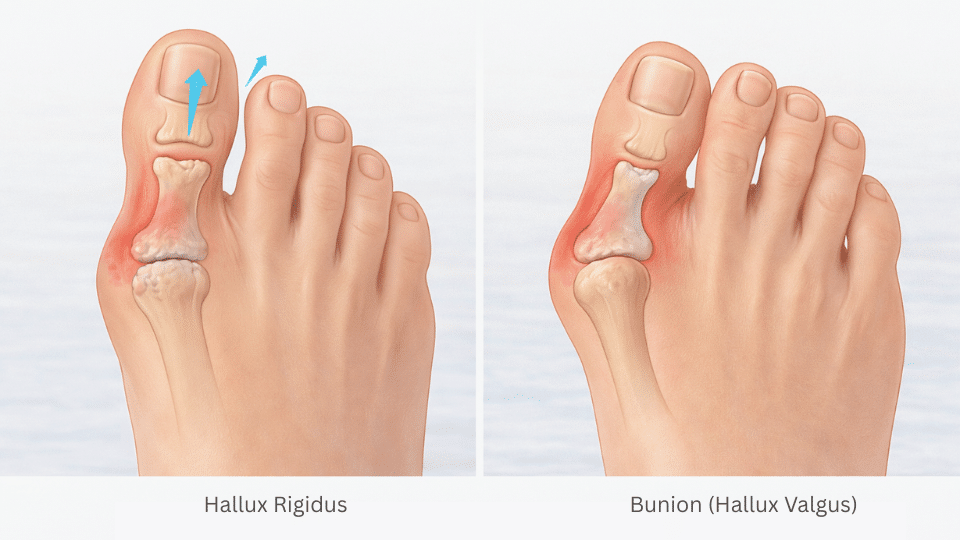
Hallux Valgus vs Hallux Rigidus
When comparing bunion vs hallux rigidus, the key difference is that hallux rigidus involves joint stiffness and arthritis, while bunions involve toe misalignment.
| Feature | Hallux Rigidus | Hallux Valgus (Bunion) |
| Primary issue | Degenerative arthritis of the big toe joint | Structural misalignment of the big toe |
| Toe movement | Limited and painful due to stiffness | Usually flexible early but shifts toward second toe |
| Visible bump | Often forms on the top of the joint (bone spur) | Appears on the side of the big toe joint |
| Pain trigger | Pain during motion, especially push-off when walking | Pain from pressure, footwear, and joint irritation |
| Joint alignment | Toe usually remains straight | Big toe gradually drifts inward toward other toes |
| Underlying cause | Joint wear, arthritis, or mechanical stress | Foot structure, genetics, and footwear pressure |
How Each Condition Is Diagnosed
Diagnosis usually begins with a clinical evaluation of the big toe joint. A podiatrist may assess the range of motion of the toe, examine joint alignment, and evaluate areas of tenderness or swelling.
In some cases, imaging such as X-rays may be used to better understand joint structure and confirm the cause of symptoms. Imaging can help identify bone spurs, joint degeneration, or the degree of toe misalignment.
Over time, some individuals with bunions may also develop bunion arthritis, which occurs when long-standing joint misalignment leads to cartilage damage within the joint. Identifying whether stiffness or deformity is the primary issue helps determine the most appropriate treatment approach.
Treatment Options for Hallux Rigidus and Bunions
Treatment depends on the underlying cause of the big toe joint problem. Because hallux rigidus involves joint degeneration while bunions involve structural misalignment, management strategies may differ. For this reason, proper evaluation and guidance from a foot and ankle specialist are important to determine the most appropriate treatment approach.
Hallux Rigidus treatments may include:
- Supportive or stiff-soled footwear to reduce joint stress
- Custom orthotics to improve foot mechanics
- Activity modifications to limit painful toe motion
- Anti-inflammatory treatments to reduce swelling
- Injections to reduce inflammation in some cases
- In more advanced cases, hallux limitus rigidus surgery
You can learn more about available treatment approaches in our guide to hallux rigidus treatment.
Bunion treatments may include:
- Wearing wider footwear that reduces pressure on the joint
- Protective padding or bunion splints
- Orthotics to improve foot alignment
- Activity adjustments to reduce irritation
- Surgical correction if the deformity becomes severe
You can explore additional information about treatment options for bunions in our related article.
When to See a Foot and Ankle Specialist
Persistent pain in the big toe joint should not be ignored, especially if symptoms interfere with walking or everyday activities. Evaluation may be helpful if you notice:
- Ongoing big toe pain or stiffness
- A visible bump near the big toe joint
- Difficulty bending the toe upward
- Swelling or irritation around the joint
- Pain that worsens with activity or certain footwear
Early evaluation can help identify whether the issue involves joint degeneration, structural misalignment, or another foot condition.
Get Help for Big Toe Joint Pain
Understanding the difference between hallux rigidus vs bunion is an important step toward choosing the right treatment and protecting long-term foot health. Although both conditions affect the same joint, they develop for different reasons and require different management strategies.
At Fall Creek Foot & Ankle, patients throughout the Humble and greater Houston area receive individualized care focused on identifying the source of foot pain and guiding the most appropriate treatment plan. If big toe joint pain is affecting your comfort or mobility, book an appointment today to receive expert evaluation and care.